

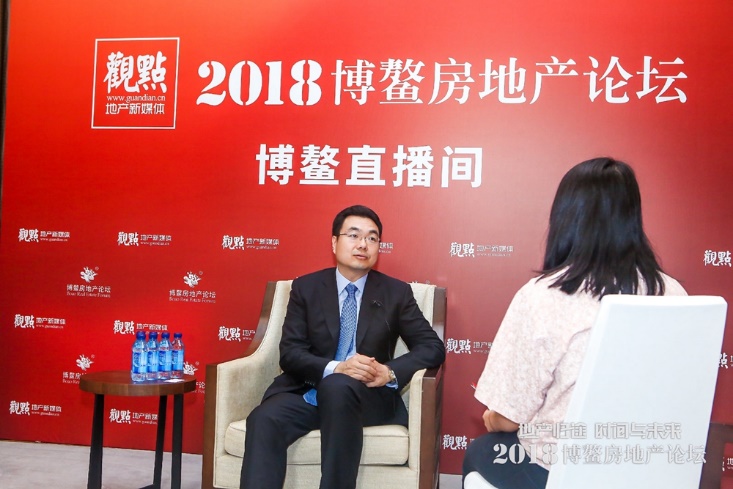
From Aug. 1 to Aug. 4, 2018, “2018 Boao Real Estate Forum” sponsored by Guandian Real Estate New Media was launched in Hainan. On the first day of the opening ceremony of the forum, Mr. Xu Yafeng, president of WINS Investment, conversed with the reporter of Guandian Real Estate New Media as a guest in the live broadcasting room of Boao, over such problems as the future space of financing development, against the background of the breakthrough of new business and the promulgation of the new regulations of asset management, and in the macro-environment of “deleveraging”,.
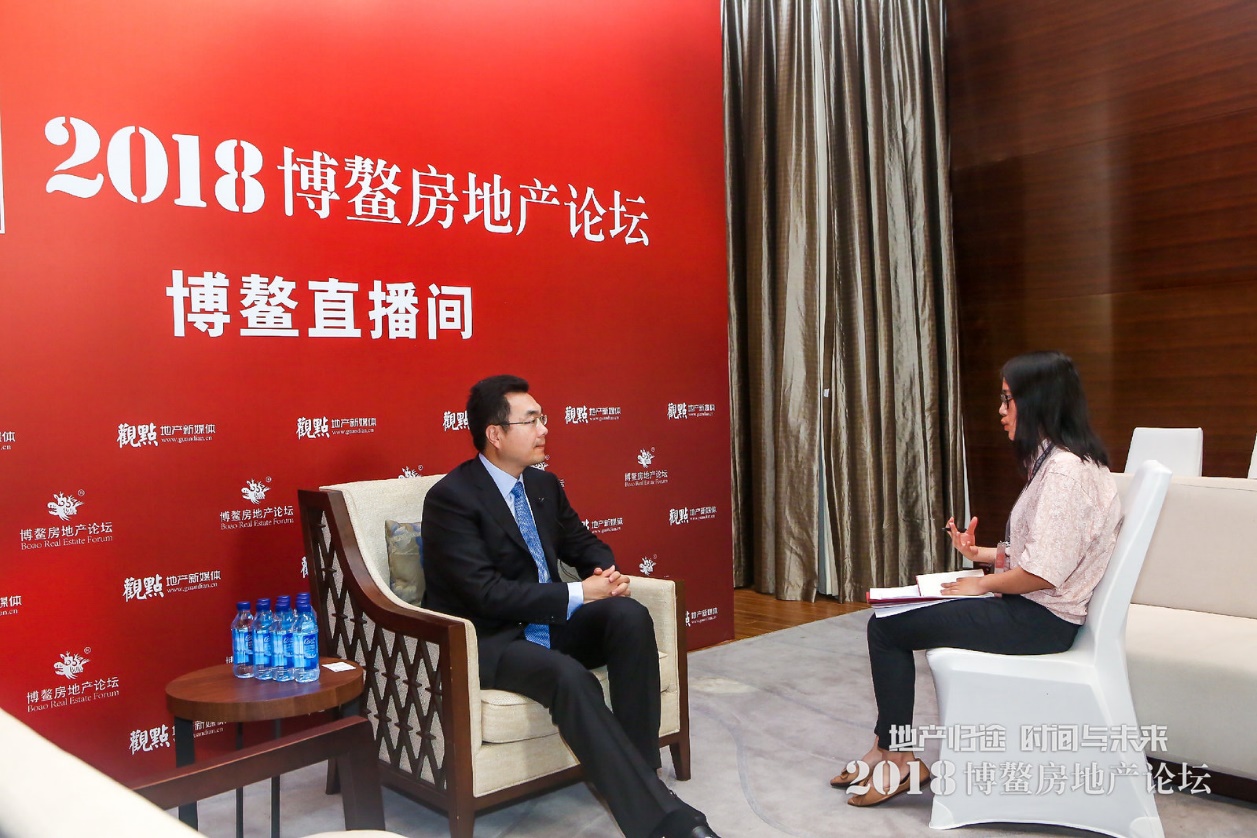
Currently, the national policy and market are both in a macro-environment of “deleveraging”. As an enterprise of real estate PE with experience of ten years, WINS has also been continuously exploring the way of survival suitable for us. Against such a background, whether financial enterprises can make a rapid response to adapt to market change is also very crucial.
Urban regeneration and stock assets will enjoy a bigger stage
First, President Xu applauded the following opinion held universally in the industry: stock assets will enjoy a bigger stage. WINS always has rich experience and advantage in the operation of development-oriented funds. WINS will continue to exert this advantage. However, since the real estate has entered the stock age, WINS has been actively carrying out innovative explorations and transformation. For example, the No. 8 Bridge project invested by WINS last year is a typical project of “light asset lease + reconstruction + operation + value increase”, and is also the first ABS product of cultural creativity park in China. In addition to its significance in financial innovation, it has opened a new financing channel for real estate enterprises specializing in light asset operation. As disclosed by President Xu, the next-step development focus of WINS will be the distribution in the field of urban regeneration, with more extensive investment directions, covering not only the type of the industrial parks of cultural creativity, but also such business types as offices, apartments for long-term rent, regional or community-oriented commercial shopping centers and industrial parks.
Expanding the innovative business of asset securitization, and hoping to make achievements in the REITs field
In addition, there is higher and higher appeal for REITs on the markets. As disclosed by President Xu, WINS will also try to make achievements in such fields as “pure REITs” while continuing to study how to expand the innovative business of asset securitization. In the opinion of President Xu, both institutions and markets have already made quite long-term and relatively sufficient preparation to welcome the launch of REITs. Only after the regulatory institutions can really provide the market with an approach of enforcement, can the institutions set up their products according to the approach of regulatory supervision. From the perspectives of urban development stages, the structure of assets and the demand and long-range choice of investors, these assets with a long-term steady return are always needed, while REITs has such a commercial logic. In particular, in the current historical stage of “using houses for residence, rather than for speculation”, this is an important means of preserving and increasing the value of investment all the more. WINS has also been actively researching and developing new products in this field, hoping to contribute to the benign and healthy development of urban regeneration and stock real estate while maintaining its leading position in financial market innovation.
Acting as the ligament of capital, cooperating with SME and realizing advantage complementation
At the mention of the impact of new regulations of asset management on the market, President Xu first said that he understood and agreed that the purpose and core appeal of regulation was compliance, which was undoubtedly beneficial for the long-term development of the entire industry. In terms of the overall policy trend, deleveraging will still continue. Therefore, we should face the adjustment of policy and the change of market with a more prudent attitude. In terms of the future long-range development trend, we should invest more in standardized products, and seek steadier assets. In such an environment, capital tends to prefer large-scale enterprises with a better operation capability, a lower risk and a lower debt ratio. Furthermore, as disclosed by President Xu, SME should take a correct attitude and concentrate on their respective advantageous resources to seek development and an outlet when they face a fund pressure. Small and medium-sized real estate enterprises may have their own unique advantage in a certain area or in a certain sphere of operation, so they should refine their work in the segmented field that they are proficient in. Because a more refined and specialized market division of labor will emerge in the future real estate industry, enterprises should accurately position themselves in this market division of labor. In this process, a very good opportunity will be brought to such a PE enterprise as WINS. As the ligament of capital, WINS exerts its advantage in capital operation, capital market rating, brand influence and fund advantage by relying on the core competitiveness of Gemdale Corp. Moreover, in connection with the unique advantages of some small and medium-sized developers, through cooperation in equity, WINS will enable the connection and mutual complementation of the advantages of these small and medium-sized and large real estate enterprises. This is also a development direction and opportunity of WINS in the future.
The following is the record of the interview of Guandian Real Estate New Media with Mr. Xu Yafeng, president of WINS Investment
Guandian Real Estate New Media: In the recent year, a lot of real estate developers have changed their name by getting rid of “real estate” in succession, so that they can become urban operators. As a matter of fact, the real estate industry has already entered the stock age. Some hold the opinion that the same goes for the PE funds of real estate as a matter of fact, because they are not limited to real estate development, and stock assets are a bigger stage for them. What do you think of this?
Xu Yafeng:I really agree with this direction. In terms of the current industrial development, the purely development-oriented business has already developed to a very extreme state. In terms of the development volume, trade volume and the high turnover strategy pursued by us, everything has been exerted to its extremity. New development space, reconstruction, promotion and overall operation of stock assets must be a broader market in the future. Let’s take a look at tier-1 cities including Beijing, Shanghai, Guangzhou and Shenzhen and top tier-2 cities including Hangzhou, Nanjing and Wuhan, and their business operation, office growth and industrial development reveal a better development prospect. Then, with regard to the reconstruction, promotion and holding operation of stock assets, acting as an urban integrated operator will bring about a better prospect for both developers and PE. In addition to such traditional advantageous business as development-oriented fund and equity fund, enterprises like WINS also emphatically reinforce the development of the business of urban regeneration fund based on stock assets.
Guandian Real Estate New Media:With regard to PE, what do you think are the spaces and advantages that can be exerted in the current stock age?
Xu Yafeng:Stock assets are not distributed in a centralized way. The government transfers land parcels in whole, but with regard to the original development business, stock assets are in a relatively scattered state. Then, this provides PE with a development opportunity, because more flexible trading capabilities and models like PE are needed under such a circumstance. Of course, stock assets would have a higher requirement for operation capability at the same time. It is not merely a simple development business. It will involve a lot of categories in the future, e.g. offices, apartments for long-term rent, industrial parks, commerce, etc. It would be a completely different industrial layout and operation logic. Therefore, at this moment, it would not be a state in which a single party can sweep the board. Only by integrating capital, operation capability, assets and other resources, can we give a better play to the glamour of stock assets.
Guandian Real Estate New Media:We have learned that the No. 8 Bridge project previously invested by WINS is also a typical case of asset securitization. Then , does WINS have a new plan and layout in urban regeneration after this project?
Xu Yafeng:The No. 8 Bridge project is really a very typical investment project of WINS in the field of urban regeneration. It is also a direction that we are most interested in. First, please allow me to introduce its business logic. In the future, we will also boost it according to a similar business logic. A very strong operation team named Qike Weixin is operating and administering the project, but it is also an entrepreneurial team with a strong operation capability, in spite of its weaker capability of capital reproduction. Therefore, under such a circumstance, as a trading consultant of asset supported securities, WINS Investment conducted all-round analysis and estimation to the cash flow and liquidity of the project and determined the pool entry assets of this project, with the help of the operation and management team of Qike Weixin, together with the Department of Asset Management of Gemdale Corp. and Gemdale Properties & Investment, and also conducted repeated discussions about the trading structure, product structure, issuance scale, etc. and worked out an innovative solution, and formed a sustainable development model for the assets themselves. As a matter of fact, after recovering the cash, the company successively invested it in two or three new projects. In this way, there is an asset operator with a good operation capability, so there is a capability of progressive development. Moreover, the fund has a development prospect of continuous investment. This year, we have launched a new fund of urban regeneration. The investment fields of this fund would be more extensive. It is not completely the original model of creative industrial park, but covers such categories as office, commerce, apartments, industrial park, etc. This is a key development direction for us this year.
Guandian Real Estate New Media: Just now, we mentioned the topic of asset securitization. This is also a new financing mode to enterprises. With regard to PE or real estate market, in which business field does asset securitization has a more brilliant investment prospect?
Xu Yafeng:In my opinion, asset securitization must have a better prospect in stock assets, because the previous development model was mostly aimed at the development of a new project, with the entire investment period lasting from land acquisition, development and construction to sales and withdrawal. However, stock assets involve longer-term capital, and long-term operation capability and investors, and a long-term ecosphere established through the capital market.
Guandian Real Estate New Media:Now, the development of REITs is also being actively boosted in China. A lot of people would feel it necessary to bring in some foreign models, e.g. Singaporean and American models. However, are they completely adaptable to the domestic realistic environment?
Xu Yafeng:In my opinion, China should draw on the overall business logic, because the USA and Singapore manufacture products under different tax laws and different capital market structures and in specific environments. However, the business logics behind them are similar, because all investors hope to acquire a long-term and steady return from this kind of assets based on asset securitization or long-term operation. Capital market can provide solutions through a corresponding capital structure, and the logic behind this is fixed. It is not necessarily launched through the American REITs structure or the Singaporean REITs structure. However, I feel that China now has the soil for launching REITs. In terms of both the urban development stages and the structure of assets, even our institutional investors, high-net-value customers, their future long-term investment choices all need this kind of assets with a long-term steady return. This is also a good means for preserving and increasing the value of investment in such a macro historical stage of “using houses for residence, rather than for speculation”.
Guandian Real Estate New Media: You have just mentioned “China now has the soil for launching REITs”. However, it has been progressing very slowly for many years. Then, which barriers need to be overcome in this regard?
Xu Yafeng: In fact, in my opinion, the barriers mentioned by everyone include trading structure, subjects, taxation, etc., all of which are some technical problems. However, there should be some ways to solve these technical problems. In China, both institutions and markets have in fact already made quite a long-time and relatively sufficient preparation. For example, in recent two years, we have witnessed the vigorous development of quasi-REITs products, which also indicates that markets would have a desirable potential. Of course, only after the entire regulatory institution can really provide us with an approach of enforcement, can the institutions set up our products according to the approach of regulatory supervision. In this process, markets would gradually approach the development of the capital market according to different trading structures or market estimations, so that a reasonable estimation can be given, and a relatively stable development market can come into being slowly.
Guandian Real Estate New Media: The detailed rules of the new regulations of asset management were promulgated on July 20. However, the rules failed to set forth clear standards for investing outsourcing funds in PE. A lot of people worry about the risk of the outsourcing PE investment being zeroed out according to the new regulations of asset management promulgated at the end of April after the transition period is over. What do you think of this?
Xu Yafeng:The new regulations of asset management and the supporting documents (exposure drafts) indeed set forth a lot of restrictions over outsourcing. For example, the business of asset management is clarified as off-balance business, the fund pool is strictly banned, rigid cashing is broken and multilayer nesting is restricted. In particular, the new regulations of financial management of the Banking Regulatory Commission and the Insurance Regulatory Commission (exposure drafts) set forth clear restrictions over non-licensed PE funds of financial management fund investment. Now, we are also paying close attention to the relevant trends. The background for the previous emergence and large-scale existence of bank outsourcing was that good PE administrators had a deeper understanding of the industry, and their fund management capability was more outstanding, so that banks (as investors with low risk preference) were also willing to hand over the funds to PE for investment and acquire a corresponding income. From this perspective, we are very confident that we can absorb extensive and high-quality investors.
Guandian Real Estate New Media:In addition, in the new regulations of asset management, PE products can in fact be invested in some non-standards and moderately expanded to small, medium-sized and micro enterprises. However, as a matter of fact, PE funds are still invested in large and state-owned enterprises and real-estate enterprises with a good income, perhaps based on security consideration. Someone would feel that this is also “drainage”. Does this also mean that SME may have difficulty obtaining a share of financing? What do you think of this?
Xu Yafeng:In my opinion, these two definitions should be made clearer. We should understand that the entire policy hopes to support small, medium-sized and micro enterprises, rather than mono-real estate enterprises. That is to say, we should encourage and boost small, medium-sized and micro industrial and start-up enterprises with proprietary brands and independent innovation capability. As far as real estate enterprises are concerned, I hold the opinion that the entire capital market, e.g. from the perspective of development trend, would slowly concentrate on more standardized large-scale enterprises with a strong operation capability. Therefore, in my opinion, these two concepts are completely different and should be differentiated from each other.
Guandian Real Estate New Media: Just as you have mentioned, this round of moderate correction of financial leveraging means that deleveraging should be boosted rhythmically. Then, which impacts would this bring to the financing environment of the real estate market in the second half of this year?
Xu Yafeng:In terms of the entire policy trend of this year, the deleveraging trend will still continue. For example, at the conference of the Political Bureau which was concluded yesterday, the attitude toward constraining the growth of housing prices is also very resolute. Therefore, in my opinion, in terms of the general trend, we must take a more prudent attitude toward investment and expectation of future capital market.
Guandian Real Estate New Media: Just as you have mentioned, SME may have a great difficulty in financing in the second half of this year, and large-scale real estate enterprises may soar higher because they may have advantage in financing. Then, is it that the financing environment for SME in the second half of this year may be not very optimistic?
Xu Yafeng:In my opinion, SME indeed will face a very big difficulty, because the trend of the entire industry is deleveraging. This process means that, 1) The industry should be standardized, which means a stricter requirement for a lot of financial institutions; 2) In the state of reduction of fund amount resulting from the process of deleveraging, funds would prefer some enterprises with a better operation capability, a lower risk and a lower debt ratio, so as to acquire a better fund support. Then, SME would face a considerable difficulty. However, I feel that this is also a development direction of the entire real estate industry. In the past 3 to 5 years, this trend was very obvious, and the entire industry moved toward large-scale enterprises. The percentages of top 50 and top 100 enterprises in the entire industry have still been rising continuously. Therefore, SME real estate enterprises should: 1) clearly see the market trend; 2) cooperate with large real estate enterprises or institutions, which would be an inevitable trend.
Guandian Real Estate New Media:Industry experts expressed such a viewpoint: SME failed to take a right attitude; therefore, whether the current trend of the industry is reshuffling or a more centralized scale, the final positioning might be: I can earn only the money that I am able to earn; I will hurriedly throw away the assets that I cannot control. Do you also think that SME should take a right attitude?
Xu Yafeng:Yes, I do. In the future, this industry will become more diversified and specialized. I do not mean that SME should withdraw from this industry and then do nothing. I mean that they should have a clearer positioning of themselves. For example, they should have a geographical advantage in a certain region, or have their own specialized development in a certain business sector, so that they can seek to cooperate with some large-scale enterprises. In addition, in the future, they can pursue specialized development in a certain professional sector, e.g. they can concentrate on office, apartment, a certain business type, cultural creativity park, industrial park, etc. In the future, more specialized market division of labor may come into being. Every enterprise should identify its own positioning in the market division of labor, rather than monopolize a certain field.
Guandian Real Estate New Media:When the concentration degree of this industry rises as a whole, small real estate enterprises may search for some other outlets? Is this a golden opportunity to PE?
Xu Yafeng:Yes. In my opinion, this process will indeed bring some opportunities to our PE. I always define WINS as a capital ligament. We are also trying to cooperate with SME real estate enterprises. As a capital ligament, WINS will enable the connection and mutual complementation of the advantages of these small, medium-sized and large real estate enterprises through equity cooperation. Now, we can notice that this business logic still has a lot of opportunities on the market. In terms of future long-term development, we should expand some holding assets while operating development funds that WINS is proficient in. However, the business logics behind them are similar. WINS should exert its advantage in capital operation, capital market rating and fund advantage by relying on the core competitiveness of Gemdale Corp. Moreover, in connection with the unique advantages of some small and medium-sized developers, WINS should explore more cooperation. I feel that this will be an opportunity in the future.

